My life is anything but normal, or at least what people think of when they think "normal". It always has been, I'm pretty used to to it by now. I've spent the majority of the last two years unable to attend school because of being sick, or in pain, or both. It's really put a huge downer on my ability to make friends at school or elsewhere. In order to make friends, you need to see each other once in awhile. That's something that just doesn't happen all that often for me.
So the topic of my 13th Birthday came up a few weeks ago when my mom asked me what I wanted to do to celebrate entering "Teen-dom". My birthday is December 13. Let me be the first to tell you that it's not a great time of year, because of this other little holiday called "Christmas" being so close. But the real problem for me isn't even competing with Christmas.
I haven't been well enough to have a birthday party since grade 4 (I'm now in grade 8), this year is shaping up to be the same way. Since I haven't been at school to build friendships, I don't think that anyone I invite to come hang out with me would come over. So I had an idea.
Why not host a public birthday party? Invite whoever would like to come out, play some games with me, chill out, have a few laughs, make a few friends, and maybe have a few surprises along the way! Then I came up with the idea that if anyone did want to give me a gift, that I would tie my birthday to Jacob's Healing Rooms project at Sick Kids to raise funds to make my wish of updating the IV infusion treatment rooms come true!
So I'm hosting Jacob's Birthday Bonanza in real life this year!! Please join me on December 10, 2016 from 1-4pm at the Whitby Curling Club, 815 Brock Street North, Whitby.
My journey living with Crohn's Disease and an Ostomy. I am raising money for The Hospital for Sick Children to update the outpatient treatment rooms so that children can have a comforting and uplifting environment that promotes healing. #JacobsHealingRooms
Monday, November 7, 2016
What Happened When I Thought No One Would Attend My Birthday
Monday, October 24, 2016
I am WE!
Last week I had an amazing opportunity suddenly come up, something that has been on my bucket list since I first heard about it: I went to WE Day!
WE Day is totally my thing. It's a day that is held in various cities around the world that brings people together to create positive change. It's a day for sharing ideas, learning from one another, and knowing that you're doing something very special - you're going to help make a difference for other people in this world. Now that should be everyone's thing.
See, we all have the power to make a difference. We all see things all the time that makes us say "whoa, stop, that doesn't seem right", and we come up with a way of seeing things differently. It doesn't matter who/what/where we are, we all have the power to choose to do something to improve this awesome planet of ours. We heard from a man, Joe Roberts, who became homeless in his teens, and because of someone treating him with the humanity he deserves, is now walking across Canada pushing a shopping cart to raise money and awareness for other homeless people (Push for Change). We heard from Rick Hansen, who after suffering a spinal cord injury in his teens, went on to travel Canada in his wheelchair advocating for those with disabilities. I think one of the coolest things I heard all night came from him - "See my abilities and not my disabilities". We heard from the sister of Chanie Wenjack, whose family, despite years of pain inflicted at the hands of our governments of past, still wanted to give us all a beautiful Aboriginal blessing. All of the stories were just incredible.
A few highpoints - seeing Gord Downie perform. Admittedly, this isn't my generation's music, I don't mind The Tragically Hip, particularly the older stuff, but it isn't my first choice. But I've been interested in Gord Downie since learning about his cancer and arranging to go on one final tour. I've been struggling personally to be able to get through what I need to in a day, that I look to people like Gord as a role model to what "really living" is. To be facing the end of your life and still take on incredible projects such as The Gord Downie-Chanie Wenjack Fund to shine a spotlight on the treatment of Aboriginals in our country is incredible. The strength and courage Gord Downie has shown has been nothing short of inspirational.

We heard from Hani Al Moulia, a young Syrian refugee who escaped the current war situation in his home city. When he left, he had nothing but his high-school diploma and the clothes on his back. Hani suffers from an eye condition that has left him legally blind, but yet he has a huge passion for photography. His pictures have even been displayed amongst pictures taken by professional photographers. Hani may have left with nothing, but he has earned himself a full scholarship to Ryerson and become a Youth Council member to the Prime Minister. Hani represents the opportunity that we all have to overcome our challenges. One of his best quotes of the night was "I won't let obstacles stop me, I'll just go around them!"
But We Day isn't about what any one person has done to make this world a better place. It's about how we COME TOGETHER to create positive change. If one person can make a difference, what can 20, 100, or 1000 people do when they come together? This is what the world needs, to come together. We need to see the problems that exist and more than just acknowledge them, take action. Even the best idea that any one person has, needs to have a team to get it into action. As Commander Chris Hadfield told us "From space, there are no borders separating us".
WE Day is totally my thing. It's a day that is held in various cities around the world that brings people together to create positive change. It's a day for sharing ideas, learning from one another, and knowing that you're doing something very special - you're going to help make a difference for other people in this world. Now that should be everyone's thing.
See, we all have the power to make a difference. We all see things all the time that makes us say "whoa, stop, that doesn't seem right", and we come up with a way of seeing things differently. It doesn't matter who/what/where we are, we all have the power to choose to do something to improve this awesome planet of ours. We heard from a man, Joe Roberts, who became homeless in his teens, and because of someone treating him with the humanity he deserves, is now walking across Canada pushing a shopping cart to raise money and awareness for other homeless people (Push for Change). We heard from Rick Hansen, who after suffering a spinal cord injury in his teens, went on to travel Canada in his wheelchair advocating for those with disabilities. I think one of the coolest things I heard all night came from him - "See my abilities and not my disabilities". We heard from the sister of Chanie Wenjack, whose family, despite years of pain inflicted at the hands of our governments of past, still wanted to give us all a beautiful Aboriginal blessing. All of the stories were just incredible.
A few highpoints - seeing Gord Downie perform. Admittedly, this isn't my generation's music, I don't mind The Tragically Hip, particularly the older stuff, but it isn't my first choice. But I've been interested in Gord Downie since learning about his cancer and arranging to go on one final tour. I've been struggling personally to be able to get through what I need to in a day, that I look to people like Gord as a role model to what "really living" is. To be facing the end of your life and still take on incredible projects such as The Gord Downie-Chanie Wenjack Fund to shine a spotlight on the treatment of Aboriginals in our country is incredible. The strength and courage Gord Downie has shown has been nothing short of inspirational.

We heard from Hani Al Moulia, a young Syrian refugee who escaped the current war situation in his home city. When he left, he had nothing but his high-school diploma and the clothes on his back. Hani suffers from an eye condition that has left him legally blind, but yet he has a huge passion for photography. His pictures have even been displayed amongst pictures taken by professional photographers. Hani may have left with nothing, but he has earned himself a full scholarship to Ryerson and become a Youth Council member to the Prime Minister. Hani represents the opportunity that we all have to overcome our challenges. One of his best quotes of the night was "I won't let obstacles stop me, I'll just go around them!"
But We Day isn't about what any one person has done to make this world a better place. It's about how we COME TOGETHER to create positive change. If one person can make a difference, what can 20, 100, or 1000 people do when they come together? This is what the world needs, to come together. We need to see the problems that exist and more than just acknowledge them, take action. Even the best idea that any one person has, needs to have a team to get it into action. As Commander Chris Hadfield told us "From space, there are no borders separating us".
Monday, September 19, 2016
I've Got This Feeling...
My life is complicated. At 12, my medication list is at times longer than those of senior citizens. I have more specialists than there are teachers at my school, or at least close to it. I have seen a doctor or health professional at minimum once a week for the last few years. I spend more time in a waiting room or doctor's office than I do anywhere else. My health prevents me from going to school for extended lengths of time, which does nothing to help build my friendships. This is my life, for better or worse. I am the one who has to live with having severe Crohn's Disease, Ehlers-Danlos Syndrome, Psoriasis, and other conditions. I'm the one who has to live with an ostomy after my colectomy, as well as a feeding tube. This is just the way my life is.
I had a recent experience which has been on my mind a lot and really bothering me. I had an encounter with a few mental health professionals who had completed an assessment focusing on the way illness has "invaded" my life. Because let's face it, chronic illness is just like an invasion. During the initial assessment meeting, my eyes had started to tear up from the dust or lighting in the room, or else from trying to hide a yawn. One of the mental health professionals was quite quick to point out in front of the group that I started crying when we started talking about a certain subject (I can't remember what it was). He went on to place all of these feeling words on me, and to make sweeping statements that in no way applied to what I was feeling. But I'm one of those kids who won't disagree with adults, at least right away without thinking about things first, so I didn't jump up and say "whoa" even though afterwards I certainly did.
What I am having a tough time accepting are the assumptions made about me without really getting to know who I am. Things like "Well a lot of kids your age Jacob feel that....", or "a lot of kids that we see like you feel....", are not predictive of how I'm feeling. I was more than happy to discuss my feelings directly when they were chatting with me. But they also needed to be willing to hear the answers that I was giving them and not put words in my mouth, or tell me what I'm feeling based on the way "most other kids" are. I am not "most other kids", I am ME. I am Jacob, and I have feelings that I'm not afraid to share. This confuses me. I can't talk about problems I don't have, and because a lot of other kids feel differently than I do, it's a problem? Since I don't have problems with being overly angry, or depressed at my situation, that's also a problem? But then on the flip side, if I only spoke of the negative, wouldn't that also be a sign of problems? And if I deny that I feel this way, than I'm just stuck in denial. And here I thought that the goal of the game was acceptance and adjusting to your new life by using positive coping skills.
I had a recent experience which has been on my mind a lot and really bothering me. I had an encounter with a few mental health professionals who had completed an assessment focusing on the way illness has "invaded" my life. Because let's face it, chronic illness is just like an invasion. During the initial assessment meeting, my eyes had started to tear up from the dust or lighting in the room, or else from trying to hide a yawn. One of the mental health professionals was quite quick to point out in front of the group that I started crying when we started talking about a certain subject (I can't remember what it was). He went on to place all of these feeling words on me, and to make sweeping statements that in no way applied to what I was feeling. But I'm one of those kids who won't disagree with adults, at least right away without thinking about things first, so I didn't jump up and say "whoa" even though afterwards I certainly did.
On our recent follow-up with them to receive the results of their assessment, it left me wondering who the heck they were talking about, because it certainly wasn't me. Another mental health professional said that I was likely internalizing my feelings because I didn't want to burden anyone with how I felt, and that when I started crying during the meeting it was a sign of deep, buried feelings. I think I'm pretty clear with my feelings and have expressed them plenty of times in very public ways such as being published on The Mighty about my experiences being bullied, and living with an ostomy.
I'm also "too accepting". It is thought that I jump to accepting my health problems too quickly and don't allow myself time to feel the negative. That acceptance is the way that I use to escape from everything that life has thrown at me. And I jump too quickly to acceptance because I feel "why bother" talking about the negative. Which goes hand-in-hand with me being "too positive", which I also use as an escape route.
This has been really upsetting for me. I've worked hard to accept that my "old self" is just that, my old self. My life has changed dramatically but it's still a good life. My mom has always said since I was born that I have a choice when it comes to bad things; I can either let it eat away at me and be miserable, or I can find a way to work around it, to adjust.
Being chronically sick takes a lot of energy out of me. Just to get through a school day right now requires every bit of my super-human strength. Feelings require energy too though, and if I spend all of my energy on focusing on the negative, that's less energy I have for everything else. Don't get me wrong, I still cry, I still get really frustrated and go off on 30 minute rants. But then I move on. I have to. If I don't keep moving on, what good is that going to do? If I chose to stay miserable, to stay in that place of anger and sadness, wouldn't this have more of a negative effect? So I chose to go to my happy place. My happy place is helping others. The feeling I get when someone says "Thanks Jacob, you're a great friend", helps me. It gives me strength to keep going. It inspires and motivates me. It makes me feel like I can accomplish anything.
What I am having a tough time accepting are the assumptions made about me without really getting to know who I am. Things like "Well a lot of kids your age Jacob feel that....", or "a lot of kids that we see like you feel....", are not predictive of how I'm feeling. I was more than happy to discuss my feelings directly when they were chatting with me. But they also needed to be willing to hear the answers that I was giving them and not put words in my mouth, or tell me what I'm feeling based on the way "most other kids" are. I am not "most other kids", I am ME. I am Jacob, and I have feelings that I'm not afraid to share. This confuses me. I can't talk about problems I don't have, and because a lot of other kids feel differently than I do, it's a problem? Since I don't have problems with being overly angry, or depressed at my situation, that's also a problem? But then on the flip side, if I only spoke of the negative, wouldn't that also be a sign of problems? And if I deny that I feel this way, than I'm just stuck in denial. And here I thought that the goal of the game was acceptance and adjusting to your new life by using positive coping skills.
I've decided to stay positive, that there's nothing "wrong" with being me. I like me. I think I'm doing an amazing awesome fantastically superb job coping so far.
Sunday, September 11, 2016
The Great Return...The School Year Begins
Stop the presses! This week I did something that I haven't really done in the last 2 years, I went to school. Not only did I finally manage to walk through the front doors, but I made it through two complete days!
It was almost like being a rock star. I walked around the corner of the school to gasps, and hearing my name over and over again. My old school friends hadn't forgotten me, which was clear since I was surrounded by people coming up to welcome me back. It's a weird feeling to try to pick up where you left off when it's been 2 years, something worthy of an episode of the Twilight Zone.
Physically, I'm exhausted. I'm in pain. And I'm constantly overheated since the class is not air-conditioned and it's hotter than India here right now. Which also means I'm constantly dehydrated. It's similar to the song about bones, except:
"The overheating is connected to the... dehydration.
The dehydration is connected to the... dizziness.
The dizziness is connected to the vomiting.
And around the loop we go".
Yet I'm still lucky. I, at least, got to experience my first day alongside everyone else. There are some kids who don't get to have this experience because they're in the hospital, or at home too sick to go, or in some type of treatment room. For once I was able to do something so incredibly "normal", that it's often taken for granted by so many of my friends. Two years away from everything has taught me to be a bit more thankful for the "normal" experiences that I do have. I may not be able to run around the school-yard with my friends, join any sports teams, or even participate in some classes with my friends (I am not allowed to do gym, and I haven't had a french class since grade 4), but I'm at least there with them.
Being away from school so much over the last 4 years, also presents it's own challenges. For example, at my school we start learning to play instruments in grade 4. My instrument of choice was the french horn, which my mom went out and bought for me. Now, let's pause and consider my instrument of choice in terms of my health. I am constantly dizzy and nauseated. The french horn, for those who have never played, requires a great deal of air control and extremely strong lip muscles. When I start to play, within minutes my dizziness has me on the floor. Holding a note for an extended length of time....I won't say impossible but certainly difficult. So, because my music teacher has to start me off from scratch, she has given me the option of changing my instrument. Thankfully my mom owns most of the instruments already, so I have the flute, clarinet, alto sax, or piano to choose from. Now to decide what the least physically demanding instrument would be!
Anyway, the big thing is I made it through the first week. It's such a huge accomplishment for me!
It was almost like being a rock star. I walked around the corner of the school to gasps, and hearing my name over and over again. My old school friends hadn't forgotten me, which was clear since I was surrounded by people coming up to welcome me back. It's a weird feeling to try to pick up where you left off when it's been 2 years, something worthy of an episode of the Twilight Zone.Physically, I'm exhausted. I'm in pain. And I'm constantly overheated since the class is not air-conditioned and it's hotter than India here right now. Which also means I'm constantly dehydrated. It's similar to the song about bones, except:
"The overheating is connected to the... dehydration.
The dehydration is connected to the... dizziness.
The dizziness is connected to the vomiting.
And around the loop we go".
Yet I'm still lucky. I, at least, got to experience my first day alongside everyone else. There are some kids who don't get to have this experience because they're in the hospital, or at home too sick to go, or in some type of treatment room. For once I was able to do something so incredibly "normal", that it's often taken for granted by so many of my friends. Two years away from everything has taught me to be a bit more thankful for the "normal" experiences that I do have. I may not be able to run around the school-yard with my friends, join any sports teams, or even participate in some classes with my friends (I am not allowed to do gym, and I haven't had a french class since grade 4), but I'm at least there with them.
Being away from school so much over the last 4 years, also presents it's own challenges. For example, at my school we start learning to play instruments in grade 4. My instrument of choice was the french horn, which my mom went out and bought for me. Now, let's pause and consider my instrument of choice in terms of my health. I am constantly dizzy and nauseated. The french horn, for those who have never played, requires a great deal of air control and extremely strong lip muscles. When I start to play, within minutes my dizziness has me on the floor. Holding a note for an extended length of time....I won't say impossible but certainly difficult. So, because my music teacher has to start me off from scratch, she has given me the option of changing my instrument. Thankfully my mom owns most of the instruments already, so I have the flute, clarinet, alto sax, or piano to choose from. Now to decide what the least physically demanding instrument would be!
Anyway, the big thing is I made it through the first week. It's such a huge accomplishment for me!
Wednesday, September 7, 2016
The What's Eating Jacob Saga Conclusion?!
Is summer really over? I've been up to so much that I haven't even realised that this was my last week before school starts for another year. Have I ever got an update to share!
A year ago we started the "What's Eating Jacob Saga" which I nicely summed up in Bad To Worse to Horrific: The Graphic GTube Story, after living with some pretty strange and severe reactions to medical products. Last week, I think we have FINALLY found some answers!!
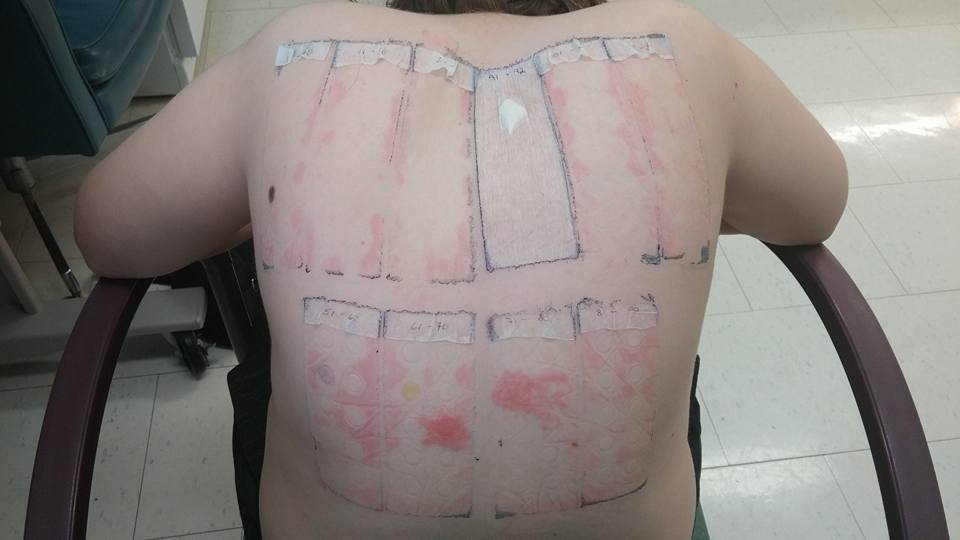
My Dermatology team from Sick Kids had referred me to another dermatologist at Sunnybrook Hospital for allergy patch testing in hopes of finding a feeding tube that I didn't react to. Unfortunately there is no direct scientific test to tell for certain if I am allergic to silicone, which we highly suspect I am, but in all we tested 90 different chemicals often found in medical products, as well as Tegaderm (IV tape) and Covidien Kendall AMD Foam Dressing.
First thing I can tell you about patch testing: It sounds easy enough. Oh yeah, we're just going to tape these little chemical extracts to your back for a few days and see what happens. It's tape, what's so bad about that?! Well not only does tape pull as you move, but if you should happen to react... I wasn't sure my skin would still be on my body by day 5.
Second thing I can tell you about the test: The results can be extremely helpful if you end up having allergies, so totally worth the annoying, itchy, burny tear-my-skin-off feelings the test creates.

We found out that I am highly allergic to:
I am highly allergic to the Covidien Kendall AMD Foam Dressing. My awesome doctor who did the patch testing is trying to get his hands on the exact chemical as it's not available for commercial patch testing in Canada, but his best guess is that I'm likely allergic to something called PHMB. The long scientific name is Polyhexamethylene Biguanide. It's used in wound-care management to help prevent and heal infections. I've been using it since about 3 weeks after I had my original GTube inserted in November last year. I've written to my patient product representative for this area to see if she would be willing to send us a sample of the extract to test, so we're just waiting to hear back. I've stopped using the foam around my GTube and things have improved a bit.
A year ago we started the "What's Eating Jacob Saga" which I nicely summed up in Bad To Worse to Horrific: The Graphic GTube Story, after living with some pretty strange and severe reactions to medical products. Last week, I think we have FINALLY found some answers!!My Dermatology team from Sick Kids had referred me to another dermatologist at Sunnybrook Hospital for allergy patch testing in hopes of finding a feeding tube that I didn't react to. Unfortunately there is no direct scientific test to tell for certain if I am allergic to silicone, which we highly suspect I am, but in all we tested 90 different chemicals often found in medical products, as well as Tegaderm (IV tape) and Covidien Kendall AMD Foam Dressing.
First thing I can tell you about patch testing: It sounds easy enough. Oh yeah, we're just going to tape these little chemical extracts to your back for a few days and see what happens. It's tape, what's so bad about that?! Well not only does tape pull as you move, but if you should happen to react... I wasn't sure my skin would still be on my body by day 5.Second thing I can tell you about the test: The results can be extremely helpful if you end up having allergies, so totally worth the annoying, itchy, burny tear-my-skin-off feelings the test creates.

We found out that I am highly allergic to:
- Decyl Glucoside and Lauryl Glucoside - two products most often found in cleansers, ironically it's in a lot of stuff for sensitive skin. It causes the cleaning product to foam up. The problem here is that the foaming hand sanitizer at the hospital, I'm allergic to it. It also hides in a lot of commerical household cleansers.
- Limonen - This comes from the rind of citrus fruits and is used in products that have fragrances, anything with that "fresh clean scent" typically has Limonen. Such as my dishsoap. The unfortunate thing here is when products just say "fragrance" in their ingredients, it could very well contain this as a hidden ingredient.
- Propolis - This comes from bee products. It's often used in face creams to hold the moisture on to your skin.
But most shockingly:
I am highly allergic to the Covidien Kendall AMD Foam Dressing. My awesome doctor who did the patch testing is trying to get his hands on the exact chemical as it's not available for commercial patch testing in Canada, but his best guess is that I'm likely allergic to something called PHMB. The long scientific name is Polyhexamethylene Biguanide. It's used in wound-care management to help prevent and heal infections. I've been using it since about 3 weeks after I had my original GTube inserted in November last year. I've written to my patient product representative for this area to see if she would be willing to send us a sample of the extract to test, so we're just waiting to hear back. I've stopped using the foam around my GTube and things have improved a bit.
Which still leaves the question as to whether I'm reacting to the actual tube itself. One of my mom's friends came up with the idea of taping an old tube to a clear spot on my skin and seeing if it reacts. When my mom asked the million dollar question - If this could actually be done - the GTube responded that it was a great idea and that they had a tube for us! So, we're going to pick up the extra tube this week when we're there for the pain clinic.
So things are moving forward and we're slowly getting some answers that I'm sure are going to make a huge difference to how I've been feeling. It's sad that it took the summer to get some answers, but there will be plenty more summers to come!
Saturday, July 30, 2016
8 Things I Say Instead of "It's Going To Be Alright" as a Parent to a Medically Complex Child
"Don't worry, it's going to be alright".
It's an innocent enough thing that we say that is meant to offer support and encouragement. When I was small and played with dolls, and my dolls had a boo-boo, this was something I said to them. My mother said it to me all the time when a problem came up. And when I became a mom, on the countless nights I spent awake with a sick baby, I would be whispering "It's ok" as I soothed him back to sleep.
I thought my job as a parent was to make things better. I'm supposed to be able to take any problem my child has and be able to work together to find the answer. I'm the boo-boo fixer, whether that boo-boo is physical or emotional. I'm the one who is supposed to be able to assure my child that everything is ok, that things aren't as bad as they seem, that any problem can be overcome with a bit of work. I'm supposed to be the super-mom, cape and all, that with a single wave of my magic wand, make everything good again.
This was my vision of motherhood, as I'm sure a lot of other soon-to-be-moms see themselves being like this too. For awhile, my life as a mother was a lot like this. Colds, ear infections, sore throats would come and go, and everything would be alright again. Growing pains would come and go, and then another period of "alrightness". I could easily soothe my growing boy, telling him "it's going to be alright".
But what about when you can no longer promise this? What happens when you can't honestly say that things are going to get better?
My days of motherhood are now spent playing a lot of other roles, but my primary one is still "boo-boo fixer". 9 years ago, Jacob was diagnosed with epilepsy. Then 4 years ago, he was diagnosed with severe Crohn's Disease. Since then, he's been diagnosed with anxiety, ADHD, severe psoriasis, Long QT Syndrome, eye inflammation, Ehlers-Danlos Syndrome/Joint Hypermobility Syndrome... He's in near constant pain, suffers multiple infections due to his immuno-suppression, and lives with daily vomiting and nausea. My vision of my role of motherhood, of being the one to help make it all right, has been completely changed.
I no longer tell my son that everything is going to be alright. That, in itself, is alright. Jacob knows enough about his medical situation to know that several of his problems have no cure, and can be difficult to manage. He was told that after he had his colectomy, things "would go back to normal, you'll be alright". That didn't happen. With each new medication we try that is supposed to "make things better" our hopes go up, only to come crashing down with severe side effects, or failure to help manage the disease it's supposed to treat. It is devastating to be promised improvement and then to experience this type of let-down. So we don't talk about things being alright in the future, instead we focus on the moment. The little things that we can do together to make each day a bit more manageable. Life has to go on, even when there is no magic wand. There's nothing "alright" with what Jacob lives with daily. There's nothing good that comes from watching your child suffer, other than the motivation it creates to keep fighting back.
How I see my job as a parent has completely changed. I no longer think that my job as a parent is to be able to take away his pain or to hide him from a painful reality. Don't get me wrong, I would give anything to be able to make him better, that still hasn't changed. My job though isn't to find a way though to take it all away, my job is to help my son to develop the skills to cope with the challenges that life has brought his way. My job isn't to protect him from all of the world's horrors, but to teach him to understand them so that he isn't afraid and to allow him to find his own way of making them better. My job is to help him appreciate the small things in life, to celebrate the small successes, and to focus on the moment rather than the long-term bigger picture.
I've watched my son grow in so many ways during his many medical crises, he's actually the one who is teaching me what it means to be a parent. Every time he has to have a painful procedure, and there's been many, he teaches me about bravery. Every time he has to try something new, something scary, he teaches me about courage. He's taught me what it means to be strong, to never give up on hope, to keep going no matter the size of mountain in your way. He's taught me about generosity through his fundraising and efforts to make a difference in this world. Most of all, he's taught me about life and love. I don't need to fix Jacob, he's the one who has fixed me. He's the one who's made me the best mom I could be to him, and also a better person. Things might never be the typical definition of "alright" so instead I say:
We can get through this.
You are so strong and brave, you can do it!
Just keep swimming.
Hold on.
This is just one moment, the next might be different.
Keep trying, keep hoping, keep dreaming.
Live for the moment, in the moment.
You are not alone.
It's an innocent enough thing that we say that is meant to offer support and encouragement. When I was small and played with dolls, and my dolls had a boo-boo, this was something I said to them. My mother said it to me all the time when a problem came up. And when I became a mom, on the countless nights I spent awake with a sick baby, I would be whispering "It's ok" as I soothed him back to sleep.I thought my job as a parent was to make things better. I'm supposed to be able to take any problem my child has and be able to work together to find the answer. I'm the boo-boo fixer, whether that boo-boo is physical or emotional. I'm the one who is supposed to be able to assure my child that everything is ok, that things aren't as bad as they seem, that any problem can be overcome with a bit of work. I'm supposed to be the super-mom, cape and all, that with a single wave of my magic wand, make everything good again.
This was my vision of motherhood, as I'm sure a lot of other soon-to-be-moms see themselves being like this too. For awhile, my life as a mother was a lot like this. Colds, ear infections, sore throats would come and go, and everything would be alright again. Growing pains would come and go, and then another period of "alrightness". I could easily soothe my growing boy, telling him "it's going to be alright".
But what about when you can no longer promise this? What happens when you can't honestly say that things are going to get better?
My days of motherhood are now spent playing a lot of other roles, but my primary one is still "boo-boo fixer". 9 years ago, Jacob was diagnosed with epilepsy. Then 4 years ago, he was diagnosed with severe Crohn's Disease. Since then, he's been diagnosed with anxiety, ADHD, severe psoriasis, Long QT Syndrome, eye inflammation, Ehlers-Danlos Syndrome/Joint Hypermobility Syndrome... He's in near constant pain, suffers multiple infections due to his immuno-suppression, and lives with daily vomiting and nausea. My vision of my role of motherhood, of being the one to help make it all right, has been completely changed.
I no longer tell my son that everything is going to be alright. That, in itself, is alright. Jacob knows enough about his medical situation to know that several of his problems have no cure, and can be difficult to manage. He was told that after he had his colectomy, things "would go back to normal, you'll be alright". That didn't happen. With each new medication we try that is supposed to "make things better" our hopes go up, only to come crashing down with severe side effects, or failure to help manage the disease it's supposed to treat. It is devastating to be promised improvement and then to experience this type of let-down. So we don't talk about things being alright in the future, instead we focus on the moment. The little things that we can do together to make each day a bit more manageable. Life has to go on, even when there is no magic wand. There's nothing "alright" with what Jacob lives with daily. There's nothing good that comes from watching your child suffer, other than the motivation it creates to keep fighting back.How I see my job as a parent has completely changed. I no longer think that my job as a parent is to be able to take away his pain or to hide him from a painful reality. Don't get me wrong, I would give anything to be able to make him better, that still hasn't changed. My job though isn't to find a way though to take it all away, my job is to help my son to develop the skills to cope with the challenges that life has brought his way. My job isn't to protect him from all of the world's horrors, but to teach him to understand them so that he isn't afraid and to allow him to find his own way of making them better. My job is to help him appreciate the small things in life, to celebrate the small successes, and to focus on the moment rather than the long-term bigger picture.
I've watched my son grow in so many ways during his many medical crises, he's actually the one who is teaching me what it means to be a parent. Every time he has to have a painful procedure, and there's been many, he teaches me about bravery. Every time he has to try something new, something scary, he teaches me about courage. He's taught me what it means to be strong, to never give up on hope, to keep going no matter the size of mountain in your way. He's taught me about generosity through his fundraising and efforts to make a difference in this world. Most of all, he's taught me about life and love. I don't need to fix Jacob, he's the one who has fixed me. He's the one who's made me the best mom I could be to him, and also a better person. Things might never be the typical definition of "alright" so instead I say:
You are so strong and brave, you can do it!
Just keep swimming.
Hold on.
This is just one moment, the next might be different.
Keep trying, keep hoping, keep dreaming.
Live for the moment, in the moment.
You are not alone.
Sunday, July 10, 2016
Four Years Later
Four years. Four years ago, I received a diagnosis that has changed my life. It's taught me a lot about strength, survival, and fighting on even when met with disappointment after disappointment. It's taught me hope, love, friendship, patience. Four years ago, I was diagnosed with severe Crohn's Disease.
Actually, I should correct that. Initially I was diagnosed with severe Ulcerative Colitis. See, Ulcerative Colitis (UC) and Crohn's Disease, are both forms of Inflammatory Bowel Disease (IBD) but can be very difficult to tell apart. Ulcerative Colitis, effects just the colon (large intestine), whereas Crohn's can be anywhere in the digestive tract. In my case, the inflammation that they saw when they did my colonoscopy was limited to my colon, and since I didn't have any non-intestinal symptoms of Crohn's, or granulomas present, they believed that I had Ulcerative Colitis. Unfortunately, 4 years hasn't changed the fact that it's still very difficult to tell the two diseases apart, and many are still misdiagnosed.
In 4 years, I've had so many treatments and procedures that it's overwhelming. I've been to the OR 15 times. At one point I was taking handfuls of 18-19 pills at a time. I had a colectomy (removal of the colon), donated my colon to research and gained a fancy bag out of the deal for collecting poop. Each medication brought new side effects, some of them tolerable, some of them a nightmare, but treatment after treatment failed to control my Crohn's and I kept getting sicker and sicker. Four years, and it's still often trial & error to find the right combo that works for the patient.
After 4 long years, my Crohn's is finally starting to get under control. That doesn't mean that I'm "better" though. I will live with this for the rest of my life, or until there is a cure. Remission is an awesome thing to achieve, but it can so easily take a turn the opposite way. I'm focusing on the fact that at least my Crohn's is now controlled so that we can look at what else is going on with my health (because the answer to that is A LOT). But that's a whole other post...
The main thing I want to share with others is HOPE. After my colectomy, things were looking so bad inside that at one point, the doctors were thinking I might have to have a major part of my small intestine removed. The doctors were stunned at just how bad it was. After the Remicade dramatically failed, leaving me with bleeding psoriasis all over my entire body, I did worry that we'd never find a treatment that worked. I worried about my future and what it would be like. Would I still be able to achieve my dreams of being a scientist (physics, chemistry) if I couldn't regularly get to school because of this? Would I always have to spend the majority of my time with doctors and nurses? The Stelara injections that the doctor started me on were, and still are, quite new to treating IBD, and not always effective. But taking a chance to see if it helped without major side effects was worth the risk compared to doing nothing. A year later and I'm no longer at risk (at the moment) for losing part of my small intestine! In fact, things look almost normal inside! There is HOPE. Sometimes it's the things that you're least confident in doing that will give you the results that you want. Keep trying. Failure is not failure so long as you get up and try a different approach. Keep moving forward. Change is scary, but if you don't make changes, things likely stay similar to the situation you're in now. Keep your head up, it does take time to find the right combo of treatments but when you do, it's a major accomplishment. You CAN do this.
Actually, I should correct that. Initially I was diagnosed with severe Ulcerative Colitis. See, Ulcerative Colitis (UC) and Crohn's Disease, are both forms of Inflammatory Bowel Disease (IBD) but can be very difficult to tell apart. Ulcerative Colitis, effects just the colon (large intestine), whereas Crohn's can be anywhere in the digestive tract. In my case, the inflammation that they saw when they did my colonoscopy was limited to my colon, and since I didn't have any non-intestinal symptoms of Crohn's, or granulomas present, they believed that I had Ulcerative Colitis. Unfortunately, 4 years hasn't changed the fact that it's still very difficult to tell the two diseases apart, and many are still misdiagnosed.
In 4 years, I've had so many treatments and procedures that it's overwhelming. I've been to the OR 15 times. At one point I was taking handfuls of 18-19 pills at a time. I had a colectomy (removal of the colon), donated my colon to research and gained a fancy bag out of the deal for collecting poop. Each medication brought new side effects, some of them tolerable, some of them a nightmare, but treatment after treatment failed to control my Crohn's and I kept getting sicker and sicker. Four years, and it's still often trial & error to find the right combo that works for the patient.
After 4 long years, my Crohn's is finally starting to get under control. That doesn't mean that I'm "better" though. I will live with this for the rest of my life, or until there is a cure. Remission is an awesome thing to achieve, but it can so easily take a turn the opposite way. I'm focusing on the fact that at least my Crohn's is now controlled so that we can look at what else is going on with my health (because the answer to that is A LOT). But that's a whole other post...
The main thing I want to share with others is HOPE. After my colectomy, things were looking so bad inside that at one point, the doctors were thinking I might have to have a major part of my small intestine removed. The doctors were stunned at just how bad it was. After the Remicade dramatically failed, leaving me with bleeding psoriasis all over my entire body, I did worry that we'd never find a treatment that worked. I worried about my future and what it would be like. Would I still be able to achieve my dreams of being a scientist (physics, chemistry) if I couldn't regularly get to school because of this? Would I always have to spend the majority of my time with doctors and nurses? The Stelara injections that the doctor started me on were, and still are, quite new to treating IBD, and not always effective. But taking a chance to see if it helped without major side effects was worth the risk compared to doing nothing. A year later and I'm no longer at risk (at the moment) for losing part of my small intestine! In fact, things look almost normal inside! There is HOPE. Sometimes it's the things that you're least confident in doing that will give you the results that you want. Keep trying. Failure is not failure so long as you get up and try a different approach. Keep moving forward. Change is scary, but if you don't make changes, things likely stay similar to the situation you're in now. Keep your head up, it does take time to find the right combo of treatments but when you do, it's a major accomplishment. You CAN do this.
Subscribe to:
Posts (Atom)